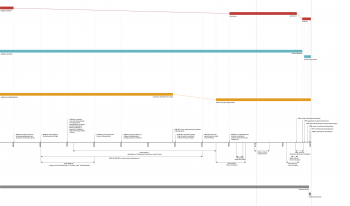
The fossil fuel era would seem to have an unambiguous point of origin in time: the late 18th century, when coal was adopted as a primary source of energy for the first time. And yet, to locate the origins of our current era in this moment places an excess emphasis on fuel while obscuring other aspects of energy transition.
The following drawing shows three simultaneous timelines that track different aspects of human-energy interactions: modes of energy capture, energy density, and the production of surplus energy. The drawing is anchored by dates and events, but its purpose is not to recount historical facts. Rather, it juxtaposes overlapping narratives, emphasizing misalignments and contradictions to show that historical rupture is often incomplete and never absolute. When one element changes, another remains constant. To focus on one may obscure what is changing in another. At stake is the question of what constitutes paradigmatic change. In climate discourse, transition is often framed in the narrow terms of renewable versus non-renewable fuels. In architecture, an aspiration for instant transgression traps discourse in a perpetual present, where newness is measured against the shallow time of the immediate past. In both cases, the terms of historical rupture have been too narrowly defined.
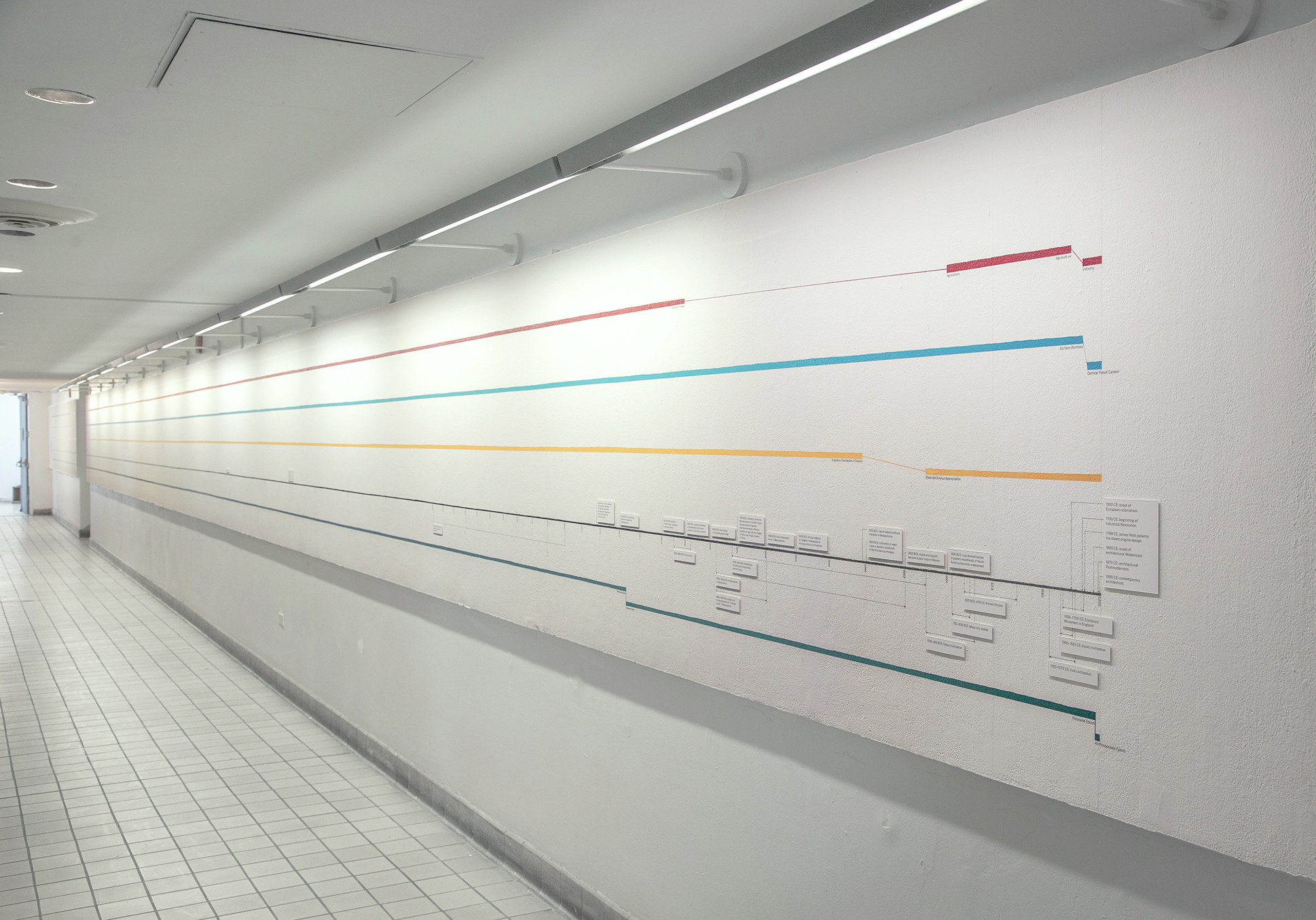
Acrylic paint, ink, vinyl lettering
This timeline makes no prescription. Rather, it offers a complex view of the many factors that are involved in epochal change. Energy transition is never merely technological—it is always also political, social, and ideological. This is particularly urgent for architecture today, for the foundations of today’s spatial paradigm lie not only in fossil fuels but in architecture’s own deep history, where appropriation and extraction are revealed to be the very foundation of the city itself. To consciously impel a break from our current system will require nothing less than a reconfiguration of our current social aims, a reinvention of the ends to which energy and labor are harnessed. Until then, architecture will continue to resist change.