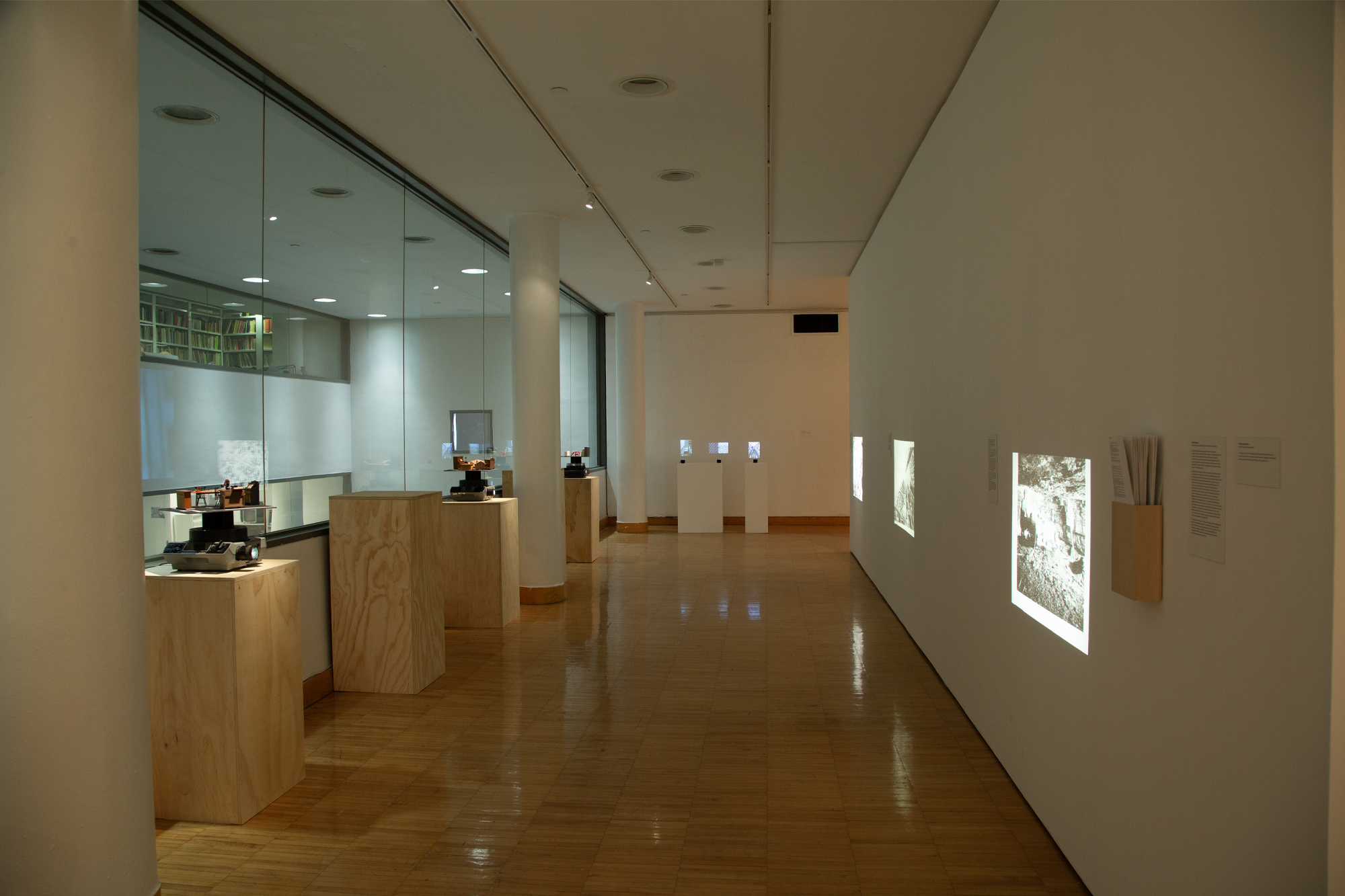
Slide projectors, acetate slides, foamcore, dollhouse furniture
Embodied Space exposes the energetic needs of the modern domestic subject. In 1964, Walt Disney exhibited a mechanized theater-pavilion at the New York World’s Fair titled Carousel of Progress. Consisting of a revolving theater, the audience seating area rotated around a circular fixed stage that showed one nuclear family over four generations. In each of the scenes, the audience witnesses technology transform their domestic lives. Drawing from the Carousel of Progress, this piece shows three models of domestic interiors. However, rather than unequivocally celebrating technological advancement, this piece focuses on specific objects within each scene and interrogates their relationship to carbon form. Each scene is mounted onto a slide carousel that projects images of the object’s ‘embodied spaces,’ a term used here to denote spaces of production that are hidden from the domestic subject’s gaze, yet are required to sustain the ‘wondrous’ feats of technological domesticity: sites of material extraction, infrastructures such as railroads and highways, industrial sites of labor exploitation, the back-of-house in department stores, wastelands, etc. The concept of embodied space alludes to the term embodied carbon—a scientific metric used to measure all the greenhouse gas emissions associated with raw material extraction, transportation, manufacturing installation and end-of-life cycle of a given product. While this term has vastly improved our understanding of human energy use, it neglects the extensive spatial networks that are as consequential as the energy itself.
This version of the Carousel of Progress showcases archival photographs that trace the embodied spaces of three domestic objects originally shown in Disney’s version, each representative of a particular historical moment: a wooden chair (1890s), an electric lamp (1920s), and a dishwasher (1940s). Together, their embodied spaces reveal the interconnected nature of carbon form.
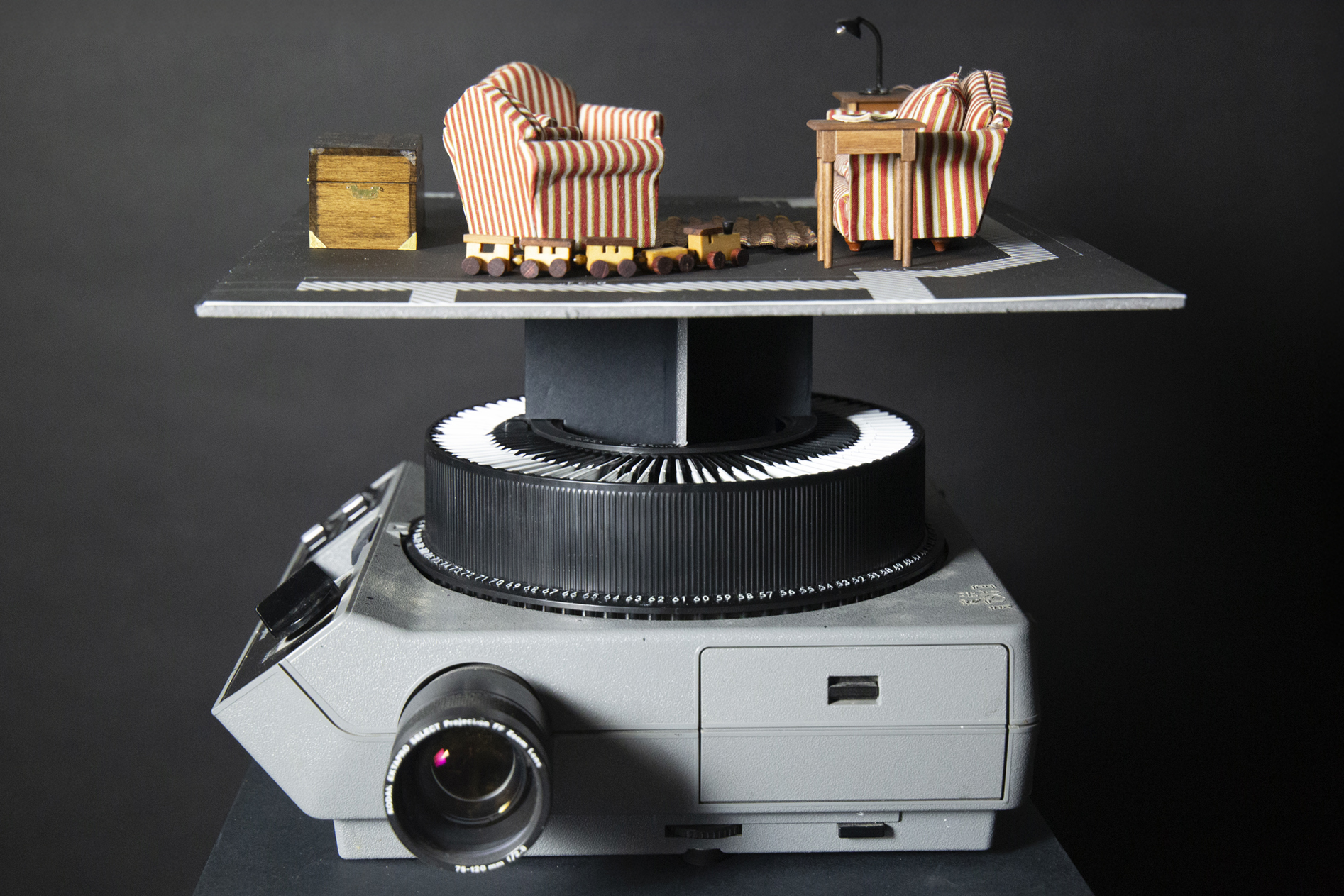
CHAIR
This model traces the embodied spaces associated with a wood chair, shown in the 1880s scene of the Carousel of Progress. Although this decade is still early in the overall history of industrialization, late nineteenth century manufacturing was already entrenched in the mass exploitation of the environment and reliant on carbon-intensive processes. The first step in the manufacturing of a chair—a product ubiquitous in the domestic realm—involves the sourcing of raw materials, namely timber and iron (used in fasteners). Loggers traveled to wilderness camps for weeks at a time, clear-cutting vast swaths of trees primarily with hand tools. In the spring, huge quantities of logs were floated down rivers to sawmills, often creating log jams along the way. Coal was the main source of energy in the 1880s. It powered the saws, the trains that transported lumber and iron ore and nails, the furnaces that smelted iron, the machines that drew the iron into wires, and the wires into nails. Sawmills were largely powered by steam from coal boilers, laying the groundwork for the increased production capacity that eventually came with electric power and later, the laser-automated saws of today. In many ways, the ubiquity of coal prepared these industrial processes for the coming of electricity, which would be the next major innovation in industrial development. Industrialization was integral to the development of consumer society. By the late nineteenth century, furniture and department stores began growing in number and size. Throughout the coming decades, this nascent industrial paradigm would further infiltrate the domestic realm, rendering home life an extension of cycles of mass extraction, production, and consumption. Although a wood chair made in the 1880s may appear to be a pre-industrial object, or perhaps even the product of an artisan, a closer look at lumber extraction sites, steel factories, and supply chains shows that the process is genuinely industrial. Disney’s Carousel of Progress may have presented the pre-electric era as one lacking the extraordinary feats of mass production, but industrial infrastructure was well established by the 1890s.
LAMP
The second scene in Disney’s Carousel of Progress introduces visitors to a newly electrified domestic space of the 1910s, now lit (or possibly over-lit) by electric lamps. This model examines the embodied spaces of both the lamp and the electricity that powers it. Sites of extraction, particularly the dark and claustrophobic spaces of coal mining, are shown alongside coal bunkers, power stations, power lines, rail infrastructure, and electrical exhibitions at world’s fairs. The embodied spaces represented throughout the sequence of images range from mineshafts (channels of space cutting through solid earth) to powerlines (channels of electricity cutting through open space) and everything in between. When focused on the lamp itself, the embodied spaces become more varied, including lamp factories, bulb testing rooms, lamp showrooms and department stores, and the flattened space of magazine advertisements. Every step of the process relies upon energy-consuming technology: electrified cart systems, drills, locomotives, water pumps, flood lighting, tools for maintenance, etc. Furthermore, every object found in these embodied spaces has its own unique suite of embodied spaces that have produced it, offering a glimpse of an overwhelmingly vast and overlapping network.
WASHING MACHINE
In the 1940s, the continued advancement of infrastructure and industry, as well as the expansion of the electric grid, contributed to the rapid appearance of home appliances within the middle-class domestic sphere. The embodied spaces of a washing machine consist of uninterrupted chains of assembly, logistics, and extraction. As such, appliances are not autonomous objects; they rely on vast infrastructural networks that tap into multiple resources: electricity, running water, and chemicals. The 1940s scene of the Carousel of Progress showcased a kitchen, where home appliances become an integral part of its spatial logic. Integrated seamlessly with the countertop, the machine condenses the spatial experience of washing and cleaning. In tracing the embodied spaces of the washing machine, however, one sees an ever-growing web of resource extraction, processing, and automated production, as well as manual labor. The small parts that constitute the cabinet-sized machine are mass-produced in separate locations, each with distinct spatial characteristics. These include: the manufacturing of steel sheets and wires, plastic injection molding, automated rubber forming, aluminum extrusion, etc. From each of these locations, one can link to another chain of natural resource extraction sites: the iron ore mine, the coal mine, the water reservoir. Furthermore, images of home appliance graveyards show these intricately assembled objects piled in a state of abandonment, no longer functional and unable to be disassembled. Together, the assembly, use, and disposal of the washing machine requires a variety of connected spaces. Some are scaled to the human body, others to an entire continent.
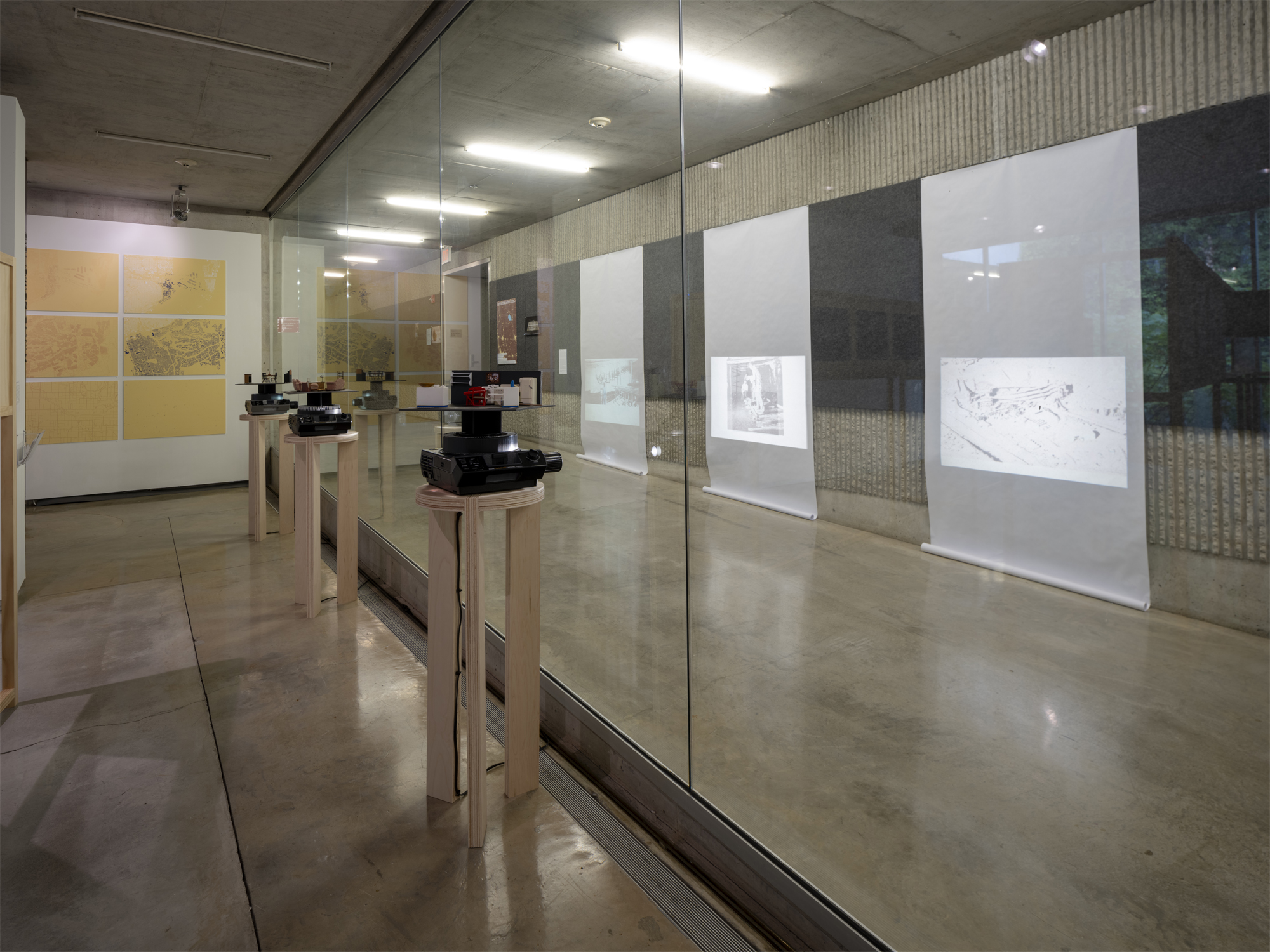
Installed at the Bibliowicz Gallery, Cornell University, September 23-October 03, 2024